

Alternative: YouTube player
The guide on YouTube
Watch this video on YouTube.
The player stays disabled until you click. Loading it connects to YouTube, which receives information including your IP address.
Watch the guide
Open internet or managed network: compare delivery paths, devices and quality factors before choosing. · 1:38
Open the dedicated video page →
Read the transcript
Same screen. Same evening. So why do we hear about OTT and IPTV? The difference is not always visible from the couch. It is mainly in the path the video takes. With OTT, content generally arrives over the public internet. Your app uses your connection to reach the service. Depending on the plan, devices and available rights, you may be able to watch some content on a television or tablet. That does not mean everything works everywhere. Managed IPTV uses a network where the operator controls distribution and quality mechanisms. Some services combine several approaches. A box, an app or an Ethernet cable alone cannot identify the system. Here is another surprise. Both can offer live television and video on demand. Yet two screens can show the same event with a delay between them. Why? Because the picture must be encoded, distributed, transported and then buffered. A good ping does not measure that whole journey. The OfficialOTT approach starts with how you watch. Does the app work on your exact device model? Does playback stay stable at home at your usual viewing times? How many simultaneous streams are included? And what are the service terms? Finally, the technology's name guarantees neither content rights nor the quality of an individual provider. OTT or IPTV, compare how it actually works, not just the label. Our guide explains the differences, hybrid services and what to check before choosing.
OTT and managed IPTV can both deliver live channels and on-demand video over Internet Protocol, but they normally organize the delivery path differently. OTT services generally reach viewers across the public Internet and do not control the subscriber’s access network end to end. Managed IPTV operates inside a service environment in which an operator controls more of the IP network, service platform and access relationship.
This is a distinction in control and service relationship, not a claim that every segment of an OTT path is public or that every managed IPTV component is physically separate from the Internet. OTT delivery may use CDNs, cloud infrastructure, private interconnection and managed backbone segments before reaching the viewer’s Internet access; IPTV implementations may likewise be hybrid or interconnected while preserving a larger operator-controlled service domain.
That distinction affects what each provider can control, how quality is managed, which devices fit naturally and how far a service can travel. It does not mean that IPTV avoids the Internet Protocol, that IPTV is always multicast, or that OTT is always unicast. It also says nothing by itself about whether content is licensed.
1. Quick answer
The core difference between OTT and managed IPTV is not “Internet versus television.” It is the relationship between the service and the delivery network.
- OTT: the media provider normally delivers through applications or browsers across the public Internet. It can optimize its platform, encoding, CDN distribution and player, but it does not manage every network between its servers and the viewer.
- Managed IPTV: the operator can coordinate the service with a controlled IP network, subscriber access, authentication and sometimes dedicated customer equipment. This can support network-level quality controls, although the actual viewing experience still depends on the complete path.
Neither architecture is universally better. The relevant choice depends on portability, operator integration, geographic reach, live-channel requirements, device flexibility and how much network control is needed.

2. Comparable definitions
What OTT describes
Over-the-top describes a delivery relationship: a media service reaches the user over an Internet connection rather than being delivered as an integrated service of the access network operator. The OTT provider may operate apps, origin systems, content delivery arrangements, analytics and playback logic, while an Internet service provider carries the traffic as part of general connectivity.
This comparison uses only the definition needed to establish that relationship. The broader OTT pillar owns the terminology, business models and complete architecture.
What managed IPTV describes
Managed IPTV describes television or audiovisual services delivered using IP within an environment where an operator manages significant service and network functions. The general ITU-T IPTV-JCA definition ties IPTV to IP-based networks managed to support required levels of QoS/QoE, security, interactivity and reliability. Specific implementations vary: one operator may integrate live channels, on-demand libraries, subscriber management and a set-top box, while another may expose apps on additional devices.
The word “IPTV” is also used loosely in marketing. An app or subscription sold over the open Internet does not automatically prove that the service uses a managed IPTV architecture. Conversely, IPTV is not a synonym for piracy, a playlist, an app or every form of streaming. This page therefore says managed IPTV whenever the network distinction matters.
3. The core difference: who controls the path?

An OTT service can control its content preparation, application and distribution partners, but traffic crosses networks it does not own. Internet routing, congestion outside its platform, household Wi-Fi and the viewer’s device can all influence playback. Adaptive delivery and distributed infrastructure help the service respond, but they do not create universal end-to-end control.
A managed IPTV operator can coordinate more layers: service platform, access network, traffic treatment, subscriber identity, customer equipment and support. That control can make certain service levels more predictable within the managed boundary. The boundary is important. A weak in-home connection, a failing cable or an overloaded device can still degrade the experience.

4. OTT vs managed IPTV comparison
| Criterion | OTT | Managed IPTV | Why it matters |
|---|---|---|---|
| Typical delivery network | Public Internet across multiple networks | Operator-controlled IP service environment | Defines how much of the path the service operator can manage |
| Access relationship | Usually independent of the Internet provider | Commonly tied to the network or service operator | Affects portability and operator dependency |
| Network control | Limited outside the service, CDN and application | Greater control inside the managed boundary | Supports traffic engineering and coordinated support |
| Quality approach | May use adaptive delivery, CDNs, buffering and application monitoring | May use network QoS and service monitoring within the managed domain | These are common architectural options, not defining requirements |
| Live delivery | Often HTTP-based unicast; other methods can exist | May use multicast for efficient channel distribution and unicast where appropriate | Architecture and audience pattern influence capacity |
| On-demand delivery | Commonly individual sessions | Commonly individual sessions within the managed service | VOD is not exclusive to either model |
| Devices | Broad app and browser reach is common | Set-top box integration is common; other apps may be supported | Determines mobility and installation expectations |
| Geographic reach | Can extend wherever service rights and suitable connectivity allow | Often limited to the operator’s service footprint | Rights and network reach are separate constraints |
| Installation | Account, compatible app and connection may be enough | May require operator activation or equipment | Changes setup and support ownership |
| Portability | App access may extend across supported devices and networks, subject to rights, region and connectivity | Mobility varies by offer; the experience may be more closely integrated with the operator environment | Compare actual device, location and account rules rather than assigning a portability score |
| Latency | Depends on live workflow, protocol, CDN, player and buffer | Depends on ingest, managed delivery, decoding and service design | Neither label guarantees lower delay |
| Resilience | May use distributed infrastructure, CDN redundancy and failover, while still facing variable network paths | May use operator-network redundancy, monitoring and failover within the managed domain | Either model can be resilient or fragile depending on implementation, device and operations |
| Analytics | Instrumented apps may collect application and session signals | Platforms may correlate service, network and subscriber signals when design and policy allow | Instrumentation varies; privacy and consent remain separate requirements |
| Security and access | App authentication, encryption and content protection | Can combine service controls with network and equipment controls | Architecture does not establish content rights or legality |
The table describes common architectural tendencies, not universal requirements. Actual implementations may combine characteristics from both models, and the quality, portability, resilience and analytics rows depend especially on implementation and policy.
5. Unicast and multicast without false absolutes
In unicast delivery, a distinct stream or session is sent toward each receiving client. This is common in OTT HTTP streaming because each player can request media segments appropriate to its conditions. It supports individualized start times, language choices and adaptive quality, but large simultaneous audiences create many sessions that the delivery architecture must distribute efficiently.
Multicast allows a network to distribute one stream to multiple receivers that join a group. A managed IPTV network may use it efficiently for popular linear channels because the operator controls multicast support inside its domain. ITU-T H.705.3 supports this specific example through its requirements and architecture for an open IPTV multicast service; it is not a general standard for every IPTV architecture. On-demand playback, pause functions and personalized advertising may still involve unicast or other service components.
Therefore, “IPTV is multicast” and “OTT is unicast” are shortcuts, not definitions. The useful question is which method an implementation uses for a particular service function and where the required network support exists. Protocol details belong in the technology pillar.

Scroll horizontally to inspect the diagram labels.
6. QoS and QoE are related, not interchangeable
Quality of service, or QoS, concerns network behaviour and resource treatment: delay, loss, jitter, prioritization and capacity are examples. A managed operator can design and monitor these characteristics within its network. ITU-T G.1080 provides an IPTV quality-of-experience framework, but it should not be turned into a universal promise for every implementation.
Quality of experience, or QoE, is what the viewer perceives. Picture stability, start time, buffering, responsiveness, audio synchronization, accessibility and device performance all contribute. Good network QoS can support good QoE, but it cannot guarantee it when the application, decoder, display or home network has a problem.
OTT services respond to variable public paths with tools such as content delivery networks, adaptive bitrate selection, buffering and application monitoring. Those tools can produce excellent playback, but outcomes remain dependent on current conditions. Managed IPTV can reduce some variables within its boundary, while still facing failures outside the portion it controls.

Scroll horizontally to inspect the diagram labels.

7. Latency, buffering and reliability
Neither label establishes a fixed latency ranking. A live stream may accumulate delay during capture, encoding, packaging, distribution, buffering and decoding. A managed channel can be designed for low and stable delay, but an OTT workflow can also be optimized for low latency. Conversely, either service can add a larger buffer to protect playback from variability.
Buffering is not automatically evidence that the business model is wrong. It can result from insufficient throughput, packet loss, congestion, Wi-Fi interference, an overloaded device, application defects or a delivery-platform incident. A dedicated guide should own connection testing and troubleshooting rather than turning this comparison into a repair manual. See the internet for streaming guide. See the buffering guide.
Reliability should be evaluated by failure domain. OTT may route around some infrastructure failures through distributed systems, yet it depends on public connectivity. Managed IPTV may offer coordinated monitoring and support, yet an operator outage can affect a large portion of its integrated service. Redundancy, operations and implementation quality matter more than the label alone.
8. Devices, applications and user flexibility
OTT commonly emphasizes applications on smart TVs, phones, tablets, streaming sticks, computers and game consoles. This can make multi-device use and portability practical, subject to service support, rights, account rules and regional availability.
Managed IPTV commonly emphasizes an operator-provided set-top box and integrated guide, authentication, live television and support. Some managed services also provide companion apps. The distinction is therefore a tendency, not a ban on particular hardware.
A viewer should verify the exact service, app version, operating system, accessibility features, audio-video support and update policy. Detailed product compatibility belongs in the Device Centre. See the Device Centre.


9. Live television and video on demand
Both models can support live and on-demand content. Managed IPTV can be efficient for a stable package of linear channels delivered within an operator footprint, particularly when multicast is used for shared live distribution. OTT can reach many device types and networks, making it practical for direct-to-consumer libraries, events and services that need broad application reach.
VOD usually requires individualized control regardless of the broader model: viewers start, pause and seek at different times. Live OTT can also add individualized features, while managed IPTV can integrate recording, replay and recommendations. “Live” and “on demand” are content experiences, not exclusive definitions of OTT or IPTV.

Scroll horizontally to inspect the diagram labels.
10. Security, access control and legality
Both architectures can use authentication, encryption, entitlement checks and content-protection systems. Managed IPTV may also associate access with a subscriber line or operator device. OTT commonly associates access with accounts, apps and supported devices. The exact controls depend on implementation.
Technology does not determine whether content is lawful. Rights, licences, distribution agreements and actual use determine legal status. A service calling itself “IPTV” is not automatically illegal, and the label does not prove legitimacy either. This comparison evaluates no provider and offers no legal opinion or circumvention instructions. Canadian regulatory context belongs in a separately maintained resource.
11. When each architecture can make sense

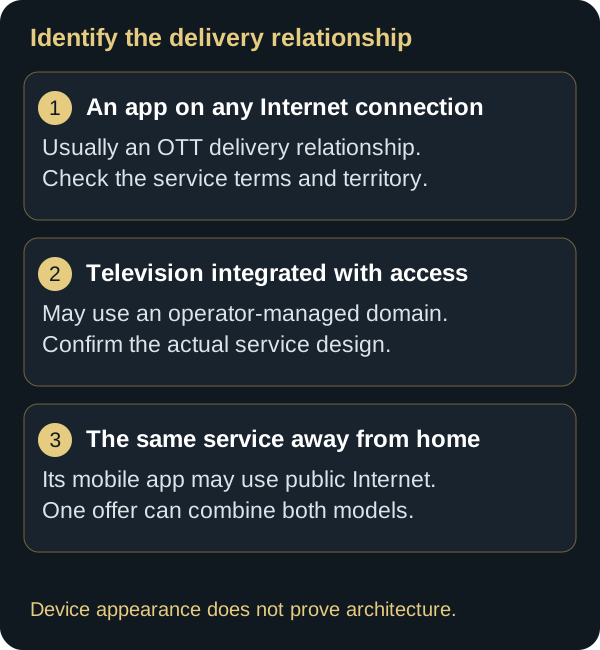
Managed IPTV can fit situations where an operator wants an integrated television product, coordinated customer support, predictable delivery inside its footprint and close alignment between the access network and service platform. It may suit households that value a unified guide, operator equipment and a conventional channel experience.
OTT can fit situations where broad device support, application flexibility, independent service choice and reach across multiple Internet providers matter. It can suit publishers that need direct customer relationships and viewers who use several screens or locations.
Many real services are hybrid. An operator may deliver a managed experience at home and a public-Internet companion app elsewhere. A media company may distribute through OTT apps while also licensing channels to managed platforms. The decision framework is therefore:
- Identify whether network-level control is essential or merely desirable.
- Separate live-channel efficiency from on-demand and personalized functions.
- Define required devices, locations and accessibility features.
- Determine whether operator integration or provider independence matters more.
- Evaluate the specific implementation, not the label.
For Canadian market context without repeating it here, consult the Canada Hub. See the Canada Hub. Commercial IPTV context remains in the separate IPTV Canada guide. See the IPTV Canada guide.

12. Common misconceptions
“IPTV does not use the Internet.” IPTV uses Internet Protocol. Managed IPTV may use a private or controlled service network rather than relying entirely on the open public Internet.
“Every video app is IPTV.” An Internet-delivered app may be OTT without being part of a managed IPTV architecture.
“IPTV always means multicast.” Multicast can be useful for linear channels in managed networks, but IPTV implementations can also use unicast and other delivery functions.
“OTT cannot provide reliable live video.” OTT quality can be strong, but it is achieved through application and delivery engineering across variable networks rather than universal access-network control.
“One architecture is always better.” Each exposes different controls and constraints. Implementation quality and the viewer’s needs decide the practical outcome.
13. Frequently asked questions
What is the main difference between OTT and IPTV?
OTT normally reaches the viewer over the public Internet without controlling the access network end to end. Managed IPTV operates in an IP service environment where an operator controls more of the delivery network and subscriber relationship.
Does IPTV use the Internet?
IPTV uses Internet Protocol. A managed IPTV service may travel through an operator-controlled network rather than across the public Internet in the same way as a typical OTT service.
Is Netflix OTT or IPTV?
Netflix’s commonly observed direct-to-consumer application delivery over general Internet connectivity fits the OTT model used in this comparison. That classification concerns this delivery relationship; it does not imply that the company or its content can never participate in other distribution arrangements.
Is IPTV always multicast?
No. Managed IPTV may use multicast for some live channels, while on-demand and personalized functions can use unicast or other mechanisms.
Which is more flexible, OTT or IPTV?
OTT may extend an app across more supported devices, networks and locations, subject to rights, region, connectivity and account rules. Managed IPTV may provide tighter operator integration and a more unified support model, while mobility depends on the specific offer. “Flexibility” therefore depends on which of those factors the viewer needs.
Is IPTV legal in Canada?
IPTV technology is not itself a legal status. Legality depends on rights, licences, distribution and use. This page does not assess any provider or provide legal advice.
Can OTT work on a smart TV?
Yes, when the television supports the service’s current application and requirements. External streaming devices can provide another option. Verify the exact model and software version.
14. Conclusion
OTT and managed IPTV are best distinguished by network relationship and control, not by a slogan. OTT generally trades end-to-end access-network control for reach and application flexibility. Managed IPTV can coordinate network and service functions more closely inside an operator environment. Both can deliver live and on-demand video; both can use several technical methods; and neither label proves quality, latency or legality on its own.
Scope and limits of this guide
This guide compares OTT and managed IPTV delivery using the cited sources. These categories describe architectures; they do not establish the quality, latency, reliability or legality of a specific offer. The guide is neither a provider benchmark nor a measurement in your home. Hybrid services may combine several mechanisms. Verify the service, its terms and applicable access rights before choosing.
15. Primary sources
Editorial and technical review: September 16, 2026. Source-based review and web checks; no household field measurements or provider certification are claimed. New photographs are AI-generated illustrations.
Sources and device categories last verified August 9, 2026.
- ITU-T IPTV Joint Coordination Activity
- ITU-T H.705.3 open IPTV multicast service
- ITU-T G.1080 IPTV quality of experience
- Apple HTTP Live Streaming
- Apple — Low-Latency HLS: mechanisms for reducing delivery delay.
- CRTC online streaming services — The CRTC link provides general regulatory context; it does not validate a particular provider’s distribution rights.
- Apple TV app device compatibility
- Netflix supported devices