
“Stable” is a promise; reliability is assessed through facts and the way problems are handled. A smooth demonstration does not show how a service will respond when a channel disappears, an account stops working or a bill raises a question. For 2026–2027, examine both technical continuity and the relationship with the provider. You do not need to believe slogans or turn every interruption into an accusation.
1. Quick answer
Establish who supplies the service, how incidents are reported, what information support requests and which cancellation conditions apply. Add your own observations across several sessions. Reliability is not a magic number: it depends on the service, your installation and how difficulties are resolved.
Five key points
- A verifiable identity matters more than a trust slogan.
- An observation needs a time, programme and device.
- An isolated problem does not identify its cause.
- A useful response leads to an action you can verify.
- A clear exit process belongs in the assessment.
- 1Identify
- 2Observe
- 3Separate possible causes
- 4Assess the response
2. Identify the business and the right contact
Before assessing picture quality, check consistency between the advertised name, support details, terms and billing entity. Differences can have legitimate explanations, but they deserve an answer. Keep a copy of useful public information. Do not provide identity documents or banking details merely to obtain a technical explanation.
The Canadian Anti-Fraud Centre advises checking web addresses and withholding authentication codes. Someone requesting a code for your own banking login is not conducting a television test. These precautions do not establish a verdict about a provider; they help keep the relationship verifiable.
Documentation: Canadian Anti-Fraud Centre — online merchandise fraud
3. Collect observations that allow comparison
Keep a small log with five fields: date and time, programme or channel, device, connection and symptom. “The picture stops and then resumes” is more useful than “it does not work”. Distinguish login failure, lower definition, video interruption, missing sound and an unavailable programme.
Repeat relevant situations at ordinary viewing times without turning the home into a permanent laboratory. In a fictional example, a problem occurs only in a bedroom while the same content works in the living room. That observation suggests investigating the local connection and device; it does not establish that the provider is either blameless or responsible.
4. Separate possible causes before changing the setup
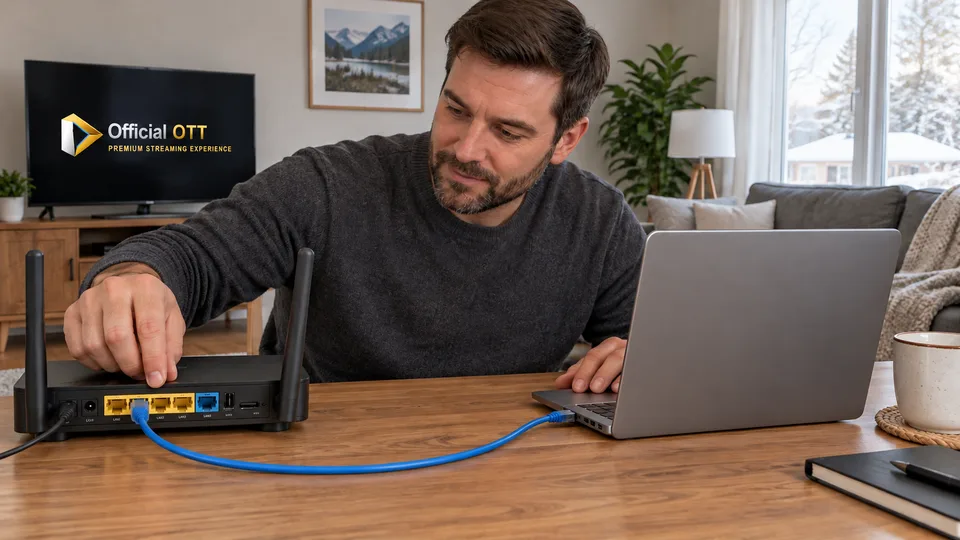
When an incident happens, first compare another programme in the same app. If necessary, test another authorized device on the same network, then a wired connection where supported. Change one thing at a time and record the result. An orderly comparison gives support a stronger starting point than repeated resets.
The result remains a clue. Improvement over Ethernet suggests looking at Wi-Fi, but does not by itself measure provider quality. One unavailable channel while others work points toward a content or stream question. Avoid changing DNS, deleting the account or resetting the television before preserving the information needed for diagnosis.
5. Assess how incidents are handled
Ask a precise question: “On this device and programme, I observe this symptom at this time. These are the comparisons already completed. What should I check next?” A relevant reply acknowledges the context, explains the proposed action and describes how to evaluate the result. An unrelated automated answer does not resolve uncertainty.
Ask where known interruptions are reported and which policy applies. The CRTC Code requires covered television providers to explain their outage and rebate policy in contractual documents. For a different service category, read the offer’s own terms rather than assuming universal compensation.
Documentation: CRTC — Television Service Provider Code
6. Check account continuity and the exit process
Reliability includes being able to retrieve a bill, correct an error and understand the next renewal. Establish who manages billing when the purchase goes through an app store or another intermediary. Uninstalling an application is not necessarily cancellation. Keep account confirmations without publishing personal information.
Set your own decision rule before becoming dissatisfied: which interruptions are tolerable for your use, what responses do you expect and how long do you want to commit? This is not a universal technical threshold. If significant uncertainties remain, shorten the commitment or consider another option. A promise of absolute availability does not replace written terms.
7. Frequently asked questions
Does a speed test prove IPTV reliability?
No. It measures a connection to a particular server at a particular time. It does not certify programme access, the app, the full streaming path or account management.
How many evenings should I test?
There is no universal number. Choose several representative situations within the trial period and its conditions. Record the observation period; do not present a brief session as evidence of year-round quality.
Does a reliable provider never have an outage?
A limited observation cannot guarantee that. Examine the frequency and impact of incidents you observe, together with the transparency and resolution offered.
Can I publish support screenshots?
Avoid exposing usernames, addresses, codes or billing information. When requesting help, share only necessary technical information through the appropriate channel after masking personal data.
8. Conclusion and limitations
Bring together three elements: an identifiable relationship, dated observations and understandable conditions. They help assess whether an offer meets your expectations. This article certifies no provider, availability level or distribution rights. It offers an assessment method whose results remain tied to your circumstances and the period observed during 2026–2027.
9. Method and sources
Documentary research conducted on October 13 and 14, 2026 using the references below. Procedures and examples form an original editorial synthesis. Illustrated scenes and interfaces are fictional: they do not represent an OfficialOTT catalogue or establish broadcasting rights. No purchase, service trial, private-account inspection or performance measurement was conducted for this article.
Editorial update and further reading: