

You have two or three exact offers and want to compare them on equal terms. This grid puts evidence side by side, highlights incompatibilities and keeps unknowns visible. Its outcome is a documented shortlist, not permission to purchase or a ranking of providers tested by OfficialOTT. The decision checklist takes over once you have selected a candidate.
1. Quick answer
Create one column per exact plan and record a status, source and date for every criterion. Rule out essential incompatibilities, leave unanswered questions open, then compare costs over the same period. The grid below shows how to distinguish a confirmation from missing information.
Five key points
- Compare exact plans rather than brand names alone.
- Keep unknown information in a separate category.
- Essential requirements take priority over an overall score.
- Calculate costs over the same period.
- Retain evidence and the date of the comparison.
- 1Identify exact offers
- 2Collect evidence
- 3Eliminate incompatibilities
- 4Make the final comparison
2. Build a short grid you can realistically complete
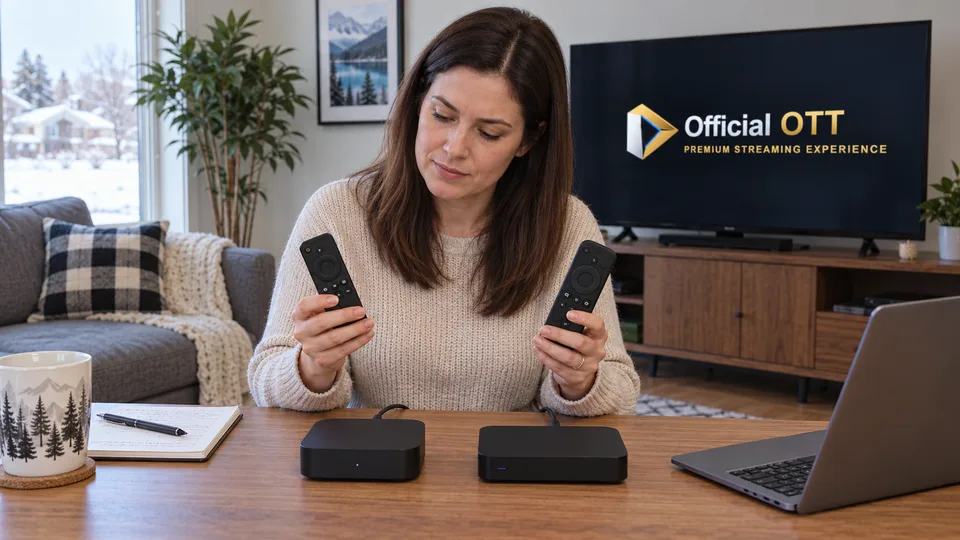
Choose two or three offers genuinely available at your address. Including ten offers increases the work without necessarily improving the decision. At the top of each column, record the provider, exact plan, relevant region and verification date. A nationwide promotion does not establish that every customer receives the same offer.
Use these rows: essential programmes; language and regional feed; main device; simultaneous streams; useful functions; complete cost; support; renewal and cancellation. Attach evidence or a link to each answer. A brochure, a support page and an observation in your home provide different kinds of evidence and should not be treated as interchangeable.
On small screens, scroll the table horizontally.
| Criterion | Offer A — exact plan | Offer B — exact plan |
|---|---|---|
| Essential programme | Unverified — no confirmation saved | Confirmed — record the broadcaster page and date |
| Main device | Confirmed — record model and source | Unverified — television generation not specified |
| Simultaneous streams | Unverified — only registered devices documented | Confirmed — record the limit and conditions |
| Cost over your period | To calculate — separate promotion and renewal | To calculate — same period and same fees |
| Provisional outcome | Wait for programme confirmation | Wait for device confirmation |
A and B do not represent real providers. These cells are sample entries, with no invented prices or test results. Replace each example with your actual source and its date. Neither fictional offer is ready for a final decision because each retains an essential unanswered question. Adding points cannot remove that uncertainty.

3. Distinguish a failure, a confirmation and an unanswered question
Write “confirmed” when a sufficiently specific source answers your requirement. Write “unsuitable” when it identifies a limitation that matters to you. Use “unverified” for a vague or missing answer. The third state prevents two mistakes: claiming a service lacks an undocumented function, or assuming it has that function because you hope it does.
For example, “two registered devices” does not establish “two simultaneous streams”. Likewise, “app available” does not prove support for your television generation. Ask a focused question about the empty cell. If it concerns your main programme or device, hold the decision until you resolve that uncertainty.

4. Put the prices on a common basis
Choose a period that matches your plan: a few months of sport, a year of television or a temporary stay. Include necessary equipment, stated fees and essential options. Handle taxes separately when advertised prices exclude them. Compare an Internet-linked offer using the complete bundle cost, rather than only the television line.
For providers covered by its Code, the CRTC requires clear information including the length of a promotion and the price afterward. Copy the written amounts and their applicable periods into your grid. Do not accidentally extend a three-month discount across twelve months. The Code does not automatically apply to every OTT application.
Documentation: CRTC — Television Service Provider Code

5. Use weighting without hiding decisive weaknesses
A score can help after you apply the essential requirements. Give high importance to everyday actions, moderate importance to occasional functions and low importance to cosmetic preferences. You can also avoid numbers and list practical advantages instead. Define priorities before seeing which offer wins.
In a fictional example, offer A is cheaper and has an attractive menu, while offer B supports an essential accessibility function confirmed on your device. That function should not be cancelled out by a few points for price or appearance. A high average can hide a decisive weakness. Do not assign a reliability score solely from a review count or a promotional screenshot.
6. Break a tie and preserve a useful record
When two offers meet the same needs, compare everyday simplicity and commitment flexibility. Record the steps required to obtain help. A useful answer to a specific question provides information, but it does not guarantee the response time of every future request.
Save the grid with its sources. Canadian Anti-Fraud Centre guidance highlights checking web addresses and the identity of online contacts. Reach provider pages through a trustworthy route before entering information. End the comparison with a sentence explaining the choice and a list of details to reconfirm at renewal.
Documentation: Canadian Anti-Fraud Centre — online merchandise fraud

7. Frequently asked questions
Must I turn the grid into a score out of 100?
No. A grid showing evidence, incompatibilities and uncertainties can be more honest than a precise numerical score. If you use points, make the weights visible and apply essential requirements first.
Can customer reviews fill the reliability row?
They can suggest questions or recurring problems to investigate. They do not replace checking context, dates and your own installation. A star average is not a technical measurement.
Does a cheaper annual plan always win?
No. Compare its commitment with the months you will actually use and the exit conditions. An annual discount can suit a durable need but be less suitable for seasonal viewing.
Does this grid prove a provider owns distribution rights?
No. It organizes available information. A logo, invoice or application does not certify permission to distribute every programme. Important rights questions still require confirmation from appropriate sources.
8. Conclusion and limitations
The aim is a traceable comparison, not a universal winner. A grid completed today remains time-specific: prices, catalogues and applications can change during 2026–2027. Keep unknown cells visible and refresh decisive information before committing. This article assigns no score or certification to a real provider.
9. Method and sources
Documentary research conducted on October 13 and 14, 2026 using the references below. Procedures and examples form an original editorial synthesis. Illustrated scenes and interfaces are fictional: they do not represent an OfficialOTT catalogue or establish broadcasting rights. No purchase, service trial, private-account inspection or performance measurement was conducted for this article.
Editorial update and further reading: